
Fifteen Years of Managing Contractor Accommodation: What Experience Prevents
Fifteen years of contractor accommodation management has taught iLodge how to prevent fragmented procurement, inconsistent supplier arrangements and avoidable project costs before they affect operations.
Categories:
What Experience Prevents
Contractor accommodation can appear straightforward when viewed from the beginning of a project. A team needs somewhere suitable to stay, local properties are available, and a few bookings need to be made. In practice, the accommodation itself is only one part of the requirement. Rates must be negotiated, suppliers need to be assessed, service expectations must be agreed, invoices must be processed, and changes need to be communicated across multiple parties. When meals, laundry and transport are added, a seemingly simple requirement can quickly become a substantial procurement and project-management responsibility.
Since 2011, iLodge has managed contractor accommodation and related services for South African companies operating away from their usual business locations. That experience has shown that most accommodation problems are not caused by a lack of available rooms. They are caused by fragmented responsibility, unclear instructions, inconsistent supplier arrangements and the absence of a single party accountable for the complete outcome.

Experience Identifies Problems Before They Reach the Project Site
Many contractor accommodation problems begin long before anyone checks in. A project team may provide an incomplete brief, accommodation may be arranged without considering transport requirements, or individual site representatives may make informal commitments directly with suppliers. Each decision may appear manageable on its own, but collectively they can create inconsistent rates, duplicated bookings, unsuitable properties and confusion about what has actually been approved.
An experienced contractor accommodation partner knows which questions need to be answered before arrangements are confirmed. How many people need to be accommodated? Will numbers change during different phases of the project? What shift patterns will affect meals and transport? Which services are included in the agreed rate? Who is authorised to approve changes? What happens when someone arrives early, leaves late or requests something outside the agreed scope?
By establishing these details upfront, iLodge helps procurement and project teams replace assumptions with a clearly managed service scope. This reduces the likelihood of disputes and gives local accommodation partners the information they need to deliver consistently.

Fragmented Procurement Creates Costs That Are Easy to Miss
The cost of contractor accommodation is not limited to the amount charged for each room. Companies also need to account for the time spent finding suppliers, requesting quotations, negotiating different rates, checking documents, arranging onboarding, processing invoices and resolving problems. When a project relies on numerous local properties and service providers, that administrative burden can spread across procurement, finance, site management and operations.
iLodge consolidates these requirements through one accountable partner and one compliant invoice. Instead of onboarding and paying every individual guest house, caterer or transport operator separately, the corporate client works through a central procurement structure. This creates clearer oversight, supports B-BBEE-compliant consolidated procurement and reduces the volume of fragmented supplier administration handled internally.
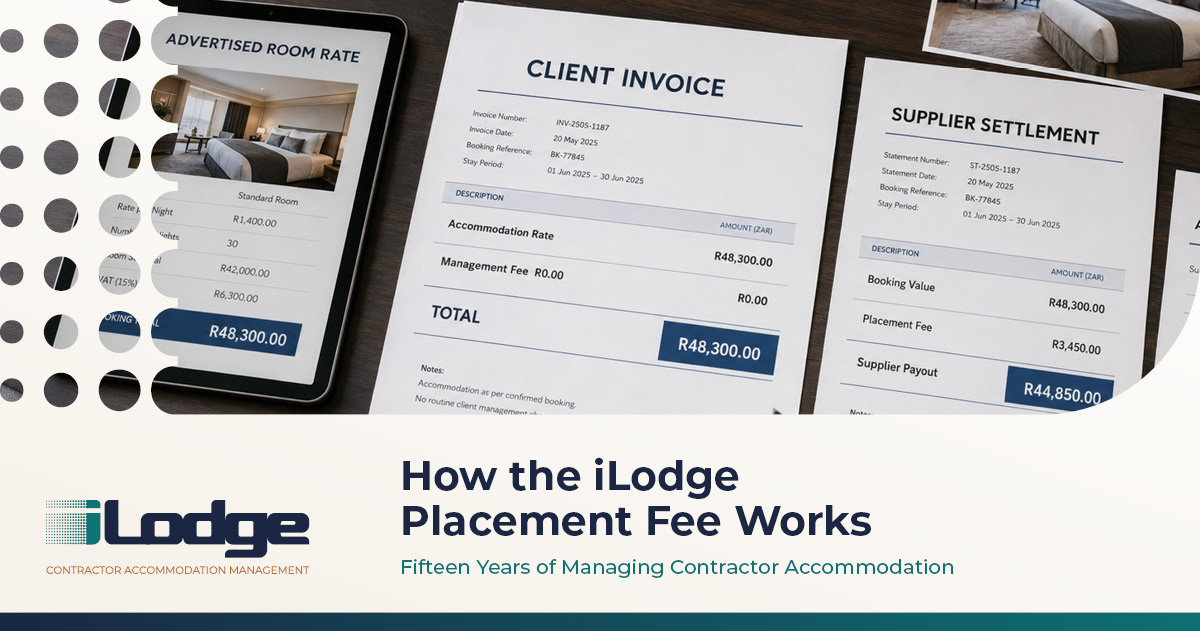
How the iLodge Placement Fee Works
iLodge charges accommodation suppliers a placement fee when a booking is successfully arranged, much like other accommodation booking platforms. This supplier-funded model allows iLodge to manage and coordinate contractor accommodation without routinely adding a separate management charge to the corporate client.
In most cases, the client pays no more than the accommodation supplier’s advertised rate. The iLodge placement fee is agreed with and paid by the supplier rather than being added as an additional line item for the client. This allows procurement and project teams to benefit from experienced coordination, consolidated procurement and supplier administration without unnecessarily increasing the accommodation rate.
Cost neutrality is not always achievable, however. Certain project requirements may involve specialised sourcing, additional administration, unusually complex coordination or related services that fall outside the standard placement arrangement. Where an additional cost is necessary, it should be clearly communicated and agreed before the service is confirmed.
The strength of the model is therefore not based on an absolute promise that every arrangement will be cost neutral. It lies in iLodge’s ability to provide accountable contractor accommodation procurement with usually little or no additional cost above the supplier’s advertised rate.

Standardisation Protects the Budget and the Service
When contractor accommodation is arranged independently across several properties, each supplier may work according to different rates, cancellation terms, meal arrangements and service expectations. Without central oversight, these differences can make the project more difficult to manage and the final cost harder to predict.
Fifteen years of operational experience allows iLodge to establish consistent processes across participating suppliers. Rates and included services are recorded, instructions are communicated electronically, and authorised changes can be distinguished from informal requests. This creates a dependable paper trail for the client and the supplier while helping to prevent misunderstandings about dates, meals, laundry, transport or additional services.
Standardisation does not mean treating every project as though it is identical. It means creating a reliable management framework that can be adapted to the actual project. A large contractor placement with changing team numbers will require a different structure from a short-term specialist deployment, but both benefit from clear approvals, recorded expectations and accountable administration.
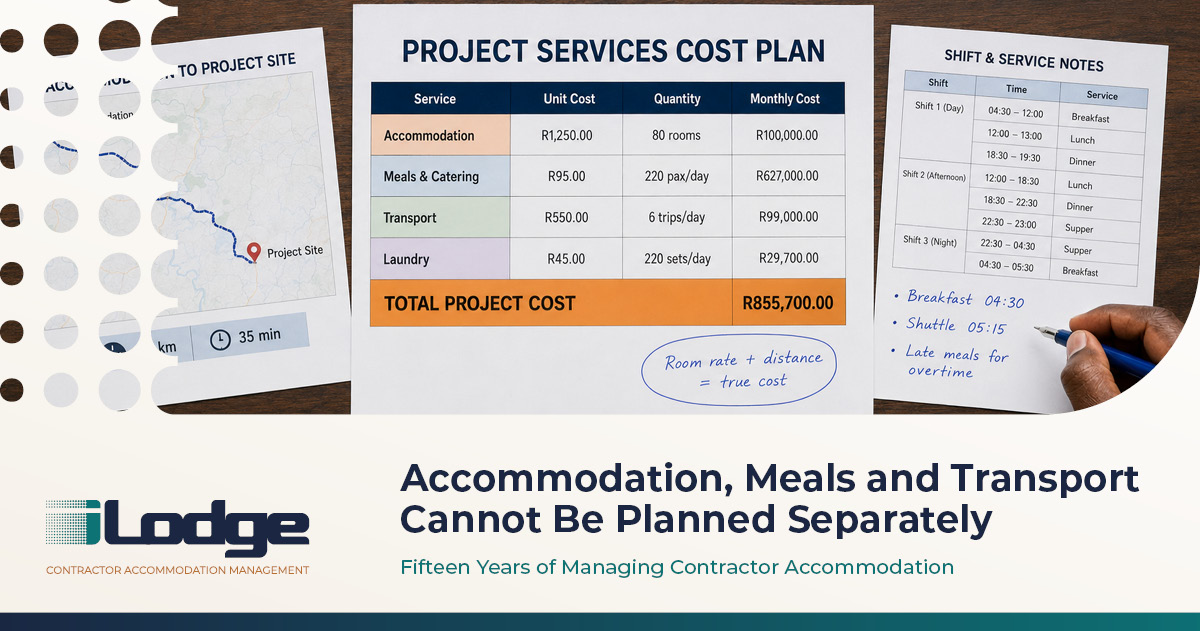
Accommodation, Meals and Transport Cannot Be Planned Separately
A property may look suitable on paper but become impractical when transport and shift requirements are considered. A lower room rate can be offset by longer travel distances, unnecessary vehicle capacity or schedules that do not align with the project. Meal arrangements can create similar problems when catering times do not match early starts, late shifts or overtime requirements.
Experienced management considers these services as connected parts of the same project requirement. iLodge can coordinate contractor accommodation together with transport, meals, catering and laundry where required. This allows the company to consider where people will stay, how they will reach the site, when they need to be fed and how service changes will affect the broader arrangement.
Bringing these requirements into one conversation creates better visibility for procurement and project leadership. It also gives local suppliers a clearer understanding of their responsibilities and reduces the risk of different providers working from conflicting information.
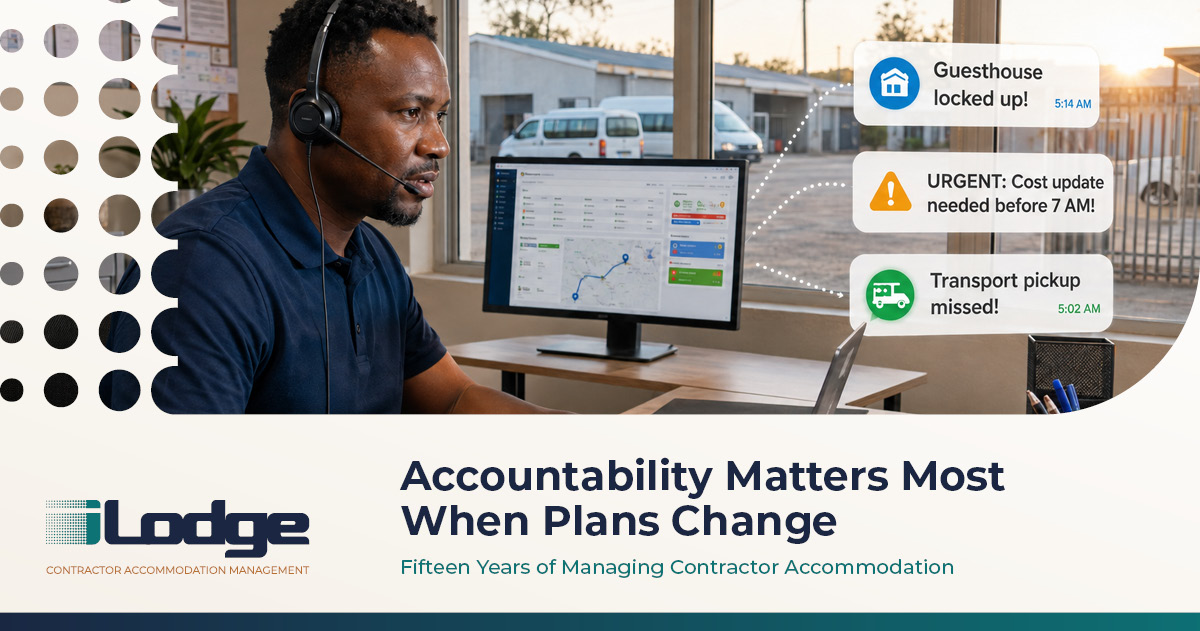
Accountability Matters Most When Plans Change
Project timelines rarely remain completely static. Start dates move, team numbers increase, shifts change and existing arrangements sometimes fail. These changes become especially difficult when responsibility is divided among several internal departments and multiple local suppliers.
iLodge remains the central escalation point when circumstances change. The client has one accountable partner to contact, while participating suppliers receive coordinated instructions through an established process. This makes it easier to manage urgent requirements, adjust existing arrangements and respond to problems without expecting a site manager or procurement team to negotiate separately with every provider involved.
An established supplier network also matters when accommodation is needed at short notice. Suitable capacity must still be identified and confirmed, but iLodge does not need to begin the entire sourcing and supplier-engagement process from the beginning each time a requirement changes.

Experience Protects Local Suppliers Too
Effective contractor accommodation management must work for both the corporate client and the local businesses providing the service. Guest houses, self-catering properties, caterers and transport operators need clear instructions, agreed rates, reliable payment processes and a recognised route for raising concerns. Without this structure, suppliers may face informal changes, unauthorised requests or uncertainty about who is responsible for resolving a problem.
iLodge acts as the accountable link between corporate procurement and participating local suppliers. This gives established small businesses an opportunity to support suitable project requirements while helping them work within a clearer corporate process. It also allows the corporate client to access local capability without having to onboard and manage every provider independently.
This balance is important. The client gains greater consistency and procurement control, while suppliers retain their independence and receive a documented service scope. Strong supplier relationships are not separate from project performance. They are one of the foundations that make reliable contractor accommodation possible.

Fifteen Years Is More Than a Number
A long track record matters because contractor accommodation cannot be managed effectively through a list of available properties alone. It requires judgement developed through changing project requirements, supplier negotiations, urgent placements, service failures, administrative pressure and real operational challenges.
Since 2011, iLodge has built its model around taking accountability for the managed outcome. The company coordinates contractor accommodation and related services, centralises supplier administration and provides the client with a consolidated procurement route. Its supplier-funded model keeps the service cost neutral to the corporate client, while its experience helps prevent avoidable problems before they begin affecting the project.
For procurement leaders and project heads, the question is therefore not simply whether accommodation can be found. It is whether the full requirement can be managed with the control, accountability and experience that the project demands.
Talk to iLodge about contractor accommodation requirements for your next project.